Construction | Econ Dev | Food & Bev | Industrial | Manufacturing | Real Estate | Startups | Technology
Construction | Econ Dev | Food & Bev | Industrial | Manufacturing | Real Estate | Startups | Technology
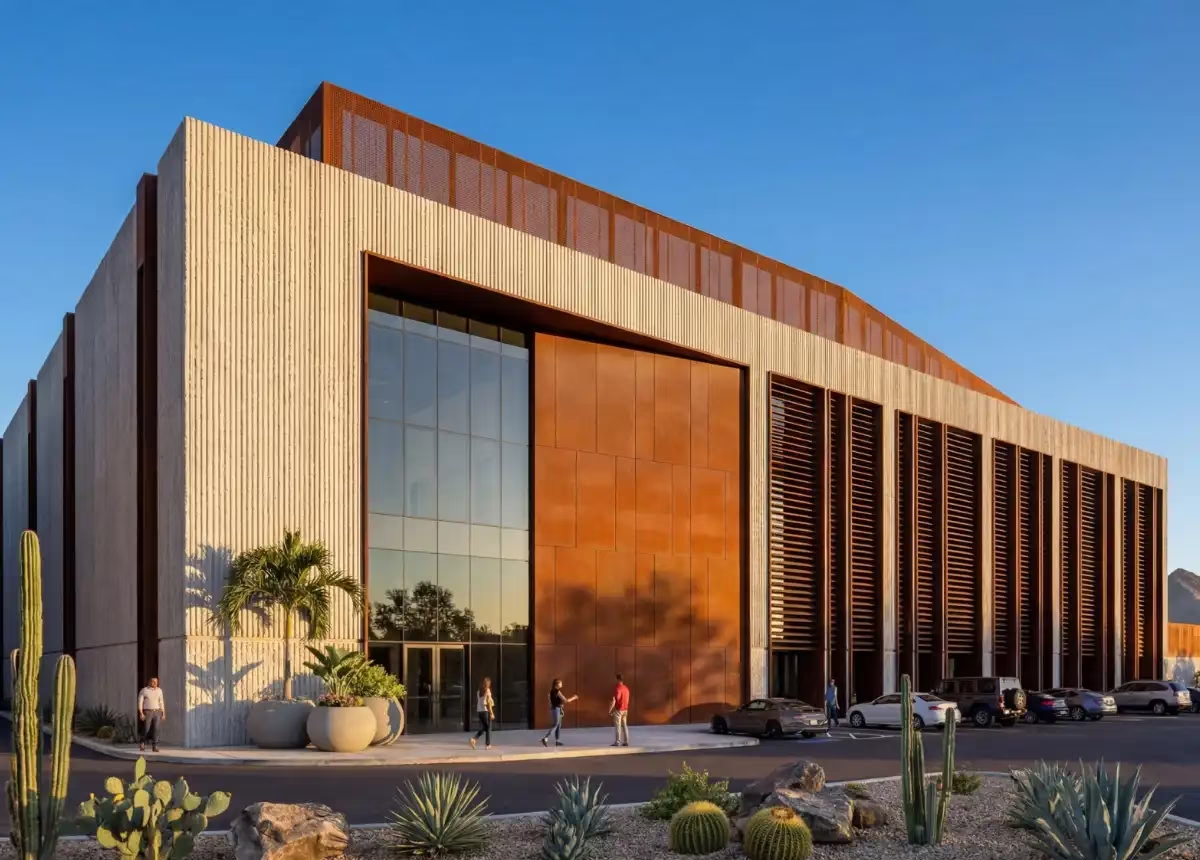
Thistle Data Center Campus rendering in Phoenix
Thistle Data Center Campus rendering courtesy of Gensler.
1 Million Square-Foot Campus
Phoenix-based architecture studio Gensler has unveiled renderings for the Thistle Data Center Campus, a hyperscale data center development in Phoenix. Designed for Menlo Digital, the project will feature a weathering steel facade and transform a former call center site near Chandler Blvd. and I-10 in Ahwatukee.
The planned campus will include five two-story data centers with capacities ranging from 36 to 72 megawatts. The facilities will span approximately 1 million square feet, supporting the growing demand for cloud computing, artificial intelligence, and digital infrastructure.
Achitecture studio Gensler has released renderings of Thistle Data Center Campus, a hyperscale data centre in Arizona, USA, with a weathering steel facade.
Designed for developer Menlo Digital, the Thistle Data Center Campus is planned for the site of a former call center in an industrial area of Arizona’s capital and largest city.
It will consist of five data centres with 36 to 72 megawatt capacity spread over the 1,000,000-square-foot campus.
The design team at Gensler wanted to create a building that would improve the appearance of the industrial site for residents in the surrounding area. Most of the current use revolves around surface parking.
“Making something that people genuinely want to look at, that adds something positive to the visual character of a neighborhood is within our power and purview as architects, it’s part of our duty,” Gensler design director Geofrey Diamond told Dezeen.
“The project offers a meaningful civic contribution, rather than a fringe benefit.”
To do this, Gensler decided to use a material palette akin to the elements of the arid climate, with red-orange weathering steel panels punctuating the facade and forming canopies over parts of the building and textured concrete for the primary cladding.
Since as much as 20 per cent of the interior may be used for office space and amenities, the entrance ways will feature recessed glass curtain walls and windows punctuated by bands of weathering steel.
But at the end of the day, the building needs to function properly to host the servers that will enable the centre to operate efficiently for tenants, who will likely be running complex AI or cloud data infrastructures.
Flexibility of function is also a priority as the project kicks off.
“We want to build a lot of flexibility into the interiors of the space, because the developer needs a building that could work for multiple kinds of clients,” Gensler technical director and global leader of critical facilities Rob LoBuono told Dezeen.
“We are building on the idea of keeping it operational for 20 to 30 years.”
This flexibility will be tempered by the security concerns of the facility, which means that few people outside of employees or contractors will see the inside of the facility.
“We have to find other ways to make a genuine contribution,” said Diamond.
“Here, the developer is providing a generously amenitized public open space at the north end of the campus.”
This energy usage, as well as questions of water and land, have been items of concern from the architecture community and environmental groups, as developers try to keep up with the demand of developers for more computational power.
“Until the physics of electricity and computing change, the infrastructure inside is always going to be resource-intensive,” said Diamond. “That’s just the reality of critical infrastructure.”
“Power plants, water treatment facilities, hospitals, data centers – these are energy-intensive by necessity, and for now, our job as architects is to mitigate that intensity as aggressively as we can through the building components we have control over,” he continued.
Diamond said that the potential for experimentation in energy transfer back to the grid as well as dialled-in, closed-loop water systems and the use of brownfields for data centres are all potential avenues for these structures to become more environmentally friendly.
Gensler was also revealed last week as the architect behind the massive Stratos Hyperscale Data Center in Utah, developed by Utah governmental organisation MIDA and development firm O’Leary Digital.
Recently, a group of researchers released a study showing that hyperscale data centres may create heat islands in their vicinity, while AtkinsRéalis and Nvidia pitched the idea of plugging small on-site nuclear reactors to data centres to take pressure off of energy grids.
Sponsor Members


About Gensler
Gensler is a leading global architecture, interiors, planning and strategic consulting firm that partners with companies to achieve measurable business and organizational goals though design. At Gensler, design puts the human experience at the center of everything we do. We have been delivering projects in Arizona for 18 years and committed to strengthening our local communities. Gensler Phoenix offers a full range of architectural, interior design, and consulting services.
Share...





Related Posts


Related Posts