Construction | Econ Dev | Food & Bev | Industrial | Manufacturing | Real Estate | Startups | Technology
Construction | Econ Dev | Food & Bev | Industrial | Manufacturing | Real Estate | Startups | Technology
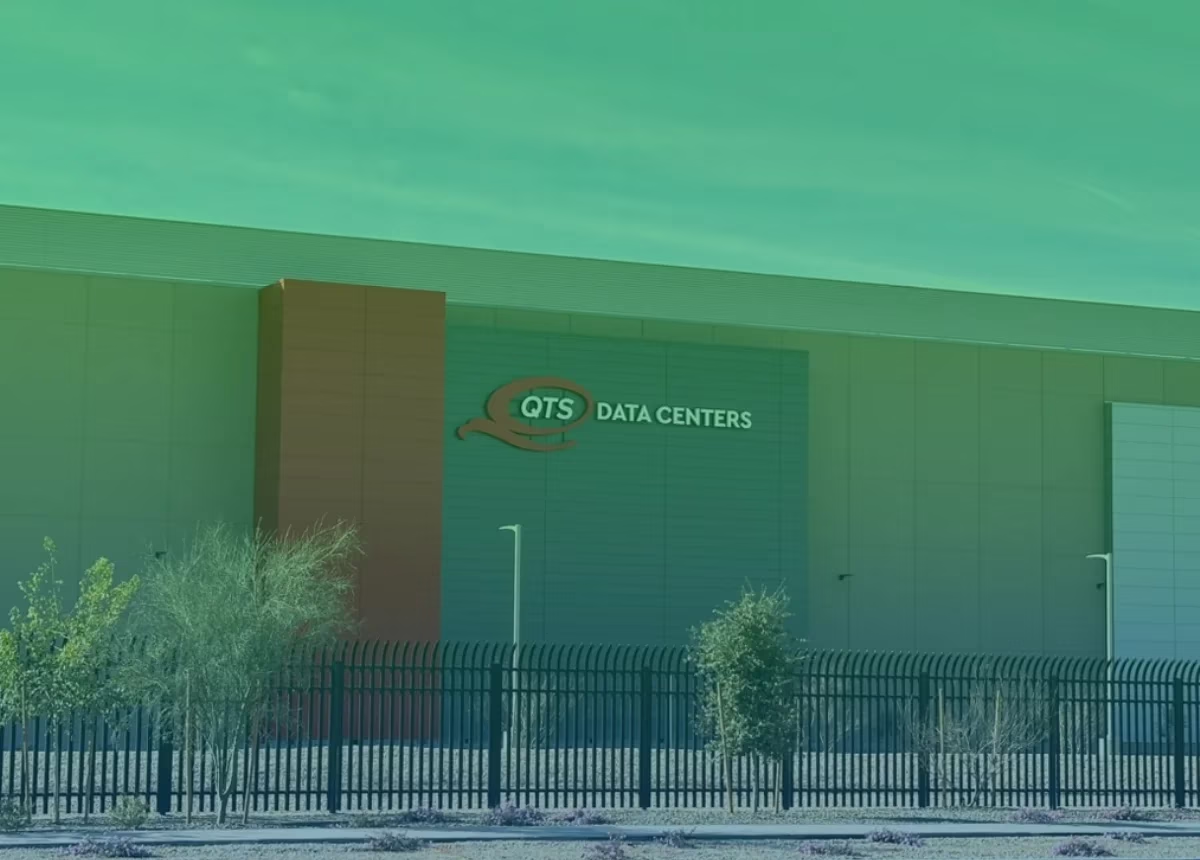
Phoenix Data Center
Photo provided by Metro Phoenix Alliance.
Data Centers Consuming Electricity
EPRI (Electric Power Research Institute) projects that data centers could consume 17% of U.S. electricity by 2030. Arizona’s demand may climb even faster than the national average. As a result, Phoenix now offers an early look at how AI infrastructure could reshape regional planning. It also highlights emerging solutions and workforce skills for professionals entering the industry.
Metro Phoenix leads the nation in AI power demand and grid innovation. However, utilities, developers, and policymakers must add new generation capacity, deploy flexible software, and implement smarter regulations to manage growth responsibly.
Phoenix Balances Surging AI Power Demand
EPRI projections show that data centers could swallow 17 percent of U.S. electricity by 2030. The same forecast pegs Arizona’s share rising even faster than the national curve. Therefore, Phoenix offers a preview of how AI infrastructure might reshape regional planning. This report unpacks the projects, numbers, and policies shaping the city’s AI Power Demand trajectory. It also highlights emerging solutions and career skills for professionals eyeing the sector.
Hyperscale Growth Accelerates Rapidly
Prime Data Centers broke ground on its PHX01 campus in May 2026. However, the headline number—240 MW of IT capacity—tells only part of the story. Buildings one through three are already leased to an unnamed hyperscaler. Additionally, Edged activated a 36 MW, water-free facility downtown in April 2026. Together, these builds add almost 280 MW of fresh load in less than a year. Consequently, the local substation queue has tightened. Frontier training clusters scheduled for PHX01 may draw 100 MW each during peak experiments.
EPRI notes that such bursts redefine AI Power Demand profiles. In contrast, inference farms consume steadier but still significant power demand over many hours. Moreover, more campuses remain confidential yet active in land-use filings. Local mayors praise new jobs, while residents worry about grid stress and higher bills. These expansion figures set the stage for discussing system pressure. Meanwhile, attention now shifts to how the network absorbs the extra megawatts.
Mounting Regional Grid Stress
Wholesale prices on the PJM grid jumped 75 percent year over year. Monitoring Analytics partly blamed rising data centers for the spike. Similarly, Arizona regulators opened dockets after Salt River Project forecast supply gaps. However, Chair Kevin Thompson warned that the three-to-five-year horizon keeps him awake. EPRI scenarios suggest Arizona’s data centers could command 16.5 percent of state electricity by 2030. Consequently, grid stress headlines moved from trade journals into mainstream outlets.
Meanwhile, average Phoenix summer peaks already test thermal generation limits. More AI Power Demand arriving without storage would tighten reserve margins further. Therefore, stakeholders explore both supply additions and flexible load tactics. These tension points illustrate the urgency of innovative responses. Subsequently, researchers turned to software orchestration for relief. In Arizona, every additional megawatt-hour now attracts scrutiny from both Wall Street and neighborhood groups.
240 MW PHX01 capacity underway
36 MW Edged site active
25 % load cut in field test
$136/MWh wholesale price after spike
These figures quantify the emerging challenge. However, technology pilots offer encouraging signals.Flexibility Tests Show Promise
Emerald AI, NVIDIA, and Oracle piloted an orchestrator called Emerald Conductor in Phoenix. The July 2025 field paper documented a 25 percent power dip across a 256-GPU cluster. Moreover, quality of service metrics stayed within agreed thresholds. The test proved that AI infrastructure can act as a controllable grid resource. In contrast, traditional demand response often shuts loads completely. Software throttled GPUs for three hours, aligning with SRP dispatch signals.
Consequently, grid stress eased during the afternoon solar ramp-down. EPRI’s DCFlex program now scales similar trials across multiple data centers. Nevertheless, productization requires verified cybersecurity and standardized telemetry. EPRI authors argue that such flexibility can offset some AI Power Demand growth. These findings prove that intelligent scheduling is not optional. However, utilities still need concrete capacity investments.
Utility Planning Responses Evolve
SRP plans to procure 3 GW of new solar tied to storage. Additionally, gas peakers remain on the table for reliability. APS follows similar strategies, citing relentless power demand curves. Meanwhile, both utilities negotiate direct service agreements with hyperscalers. Regulators may approve special tariffs to shield everyday customers from cost shifts. In contrast, some advocates push for mandatory onsite renewables at compute campuses. Consequently, environmental groups watch water-free cooling claims closely.
Utilities also study small modular nuclear options to meet AI Power Demand after 2030. These planning moves reveal mixed resource portfolios. Subsequently, debates pivot toward economic and ecological tradeoffs. Meanwhile, legislators debate whether peak pricing should follow marginal emissions factors.
Economic Environmental Tradeoffs Emerge
Construction crews, engineers, and suppliers gain steady employment from each campus. Moreover, municipalities enjoy fresh tax revenue and fiber upgrades. Nevertheless, critics fear ballooning electricity rates if power demand outpaces supply. Water scarcity also worries ranchers despite Edged’s air-cooling design. EPRI data show that AI infrastructure heats more efficiently than legacy silicon, yet still draws high instantaneous current. Consequently, project sponsors tout grid-interactive designs as a mitigation path.
Arizona State economists estimate each 100 MW campus adds $150 million to regional GDP. However, stranded costs could negate benefits if grid stress prompts emergency generation. These pros and cons underscore the stakes. Therefore, policy deliberations have intensified. Subsequently, workforce programs at community colleges pivot toward data center electrical apprenticeships.
Policy Debates And Actions
The Arizona Corporation Commission opened multiple dockets on interconnection, rates, and emissions. Additionally, task forces examine transmission timelines and siting reforms. Lawmakers discuss requiring large data centers to fund line upgrades upfront. In contrast, industry groups prefer voluntary load-flex pledges. Furthermore, EPRI recommends performance-based incentives for grid-interactive AI infrastructure. Kevin Thompson signals openness to novel tariffs that reflect AI Power Demand patterns. Meanwhile, PJM’s monitoring unit urges other regions to act before wholesale shocks spread. Consequently, national agencies watch Phoenix as a template. These policy dialogues will shape market rules. Subsequently, professionals must update skills to stay relevant.
Skills And Career Pathways
Engineers with power systems literacy now command premium salaries at hyperscale operators. Moreover, software architects who can blend machine-learning pipelines with SCADA earn rapid promotions. Professionals can enhance expertise with the AI Architect™ certification. Additionally, grid-flex research offers fertile ground for doctoral projects. Market analysts who grasp AI Power Demand trends advise venture funds and municipalities. Consequently, interdisciplinary fluency becomes a differentiator. These career avenues reflect the sector’s momentum. Therefore, staying informed provides a competitive edge.
Phoenix stands at the forefront of AI Power Demand and grid innovation. However, meeting that AI Power Demand responsibly will require new generation, flexible software, and smart regulation. Utilities, developers, and policymakers must collaborate before megawatt curves outrun construction schedules. Moreover, early demonstrations prove that data centers can cooperate with the grid rather than overwhelm it. Consequently, professionals who master both AI infrastructure and energy economics will shape the next decade. Explore certifications, engage stakeholders, and lead Phoenix toward a balanced digital future.
Sponsor Members


Share...






Related Posts




Related Posts