Construction | Econ Dev | Food & Bev | Industrial | Manufacturing | Real Estate | Startups | Technology
Construction | Econ Dev | Food & Bev | Industrial | Manufacturing | Real Estate | Startups | Technology
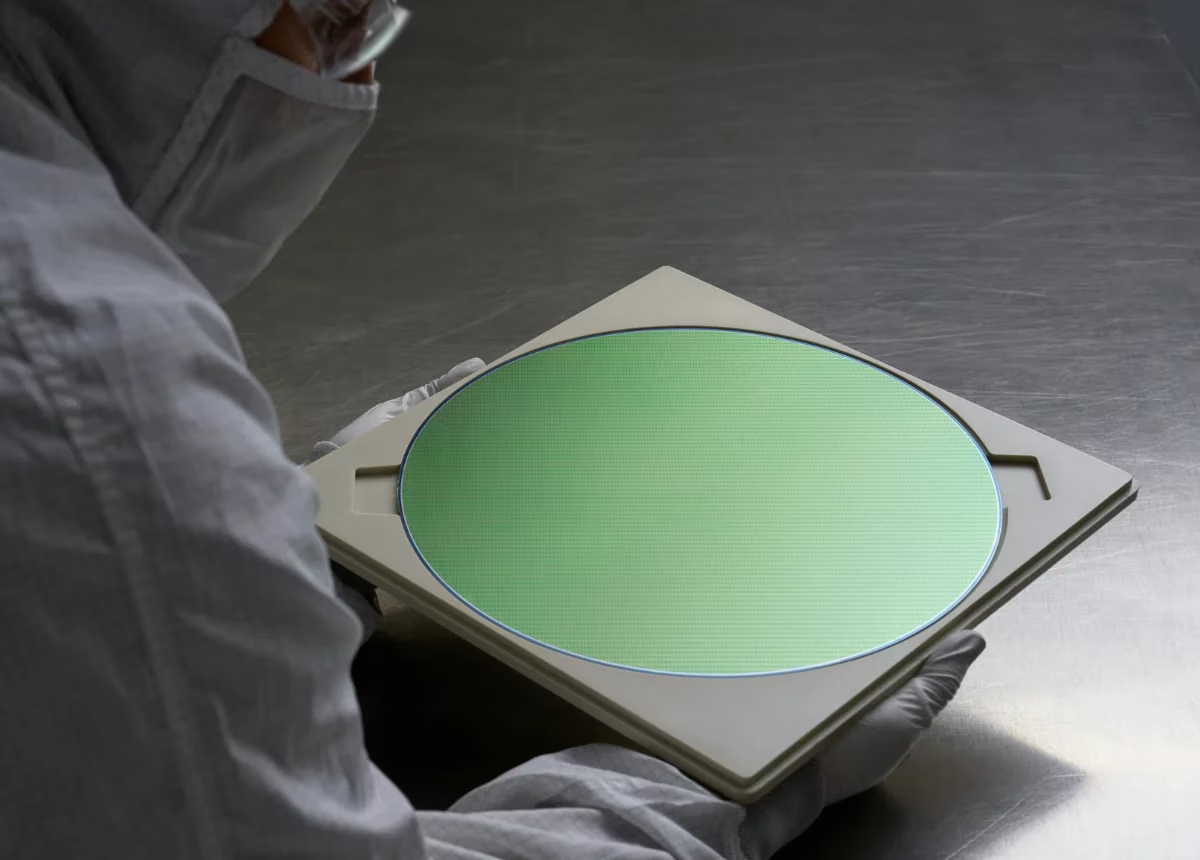
Apple Silicon
Semiconductor Manufacturing Leaders
Arizona and Ohio have become leading semiconductor manufacturing centers, earning the nicknames the “Silicon Desert” and “Silicon Heartland.” The push to bring chip production back to the United States supports national security, strengthens supply chains, and advances America’s position in AI and advanced computing.
The industry still faces major challenges. The Semiconductor Industry Association expects nearly $650 billion in fab and infrastructure investments over the next decade, creating more than 115,000 jobs. However, talent shortages could leave roughly 67,000 positions unfilled. U.S. fabs also cost significantly more to build and operate than facilities in Asia. This places added pressure on efficiency, product quality, and profitability.
Much of the sector’s recent momentum also depends on AI-driven chip demand. High-value AI chips generate nearly half of semiconductor market revenue despite representing a small share of total unit sales. If AI demand weakens, manufacturers could face revenue swings while carrying massive long-term investments. Industry leaders must expand workforce training, control costs, and diversify demand to sustain long-term growth and economic impact.
Semiconductors are a core component in most modern electronic devices, powering everything from smartphones and electric toothbrushes to computers and video games.
In recent years, their ability to transform how we work, communicate, and travel has seen them evolve from commercial products into strategic assets. They are critical for modern defense systems, secure communications, advancements in AI, and cutting-edge medical equipment, and they power our data centers, quantum computers, electric vehicles, and industrial robotics systems.
As ensuring reliable access to high-performance chips becomes an issue of national and economic security, a growing number of US manufacturers are reshoring their operations.
Let’s explore the factors driving the recent wave of reshoring efforts, the emergence of Ohio’s “Silicon Heartland,” and the challenges ahead for US semiconductor manufacturing.
Semiconductor Supply Chain Challenges
The US dominated the semiconductor industry from its inception in 1947 until the late 1980s, when manufacturers began offshoring production to East Asian countries. Fueled by lower operational costs and extensive government support in host countries such as Taiwan, South Korea, and China, the nation went from producing 65% of the global semiconductor supply in the late 1970s to just 10% in 2022.
This strategy worked well for a few decades, improving profitability and efficiency and allowing US semiconductor companies to focus on design and innovation, rather than logistics and manufacturing. However, the disruptive geopolitical events of the past decade highlight the major risks associated with just-in-time supply chains and reliance on foreign manufacturing.
After the COVID-19 pandemic, for example, the surge in demand for consumer electronics, coupled with three years of major supply chain disruptions, led to a severe global semiconductor shortage. Automotive plants shut down, new product launches were postponed, and companies across dozens of industries lost substantial revenue. Since then, rising political tensions and trade disputes between the US and China have threatened to further destabilize the semiconductor supply chain.
Seeking to bolster national security, ensure domestic superiority in AI and military technology, protect critical supply chains, and reduce reliance on Asian manufacturing hubs, the nation turned its focus to reviving domestic chip production.
In 2022, the CHIPS and Science Act allocated $52 billion in subsidies and tax credits for chip manufacturing companies, and $200 billion for research into AI, quantum computing, and robotics. This includes a 25% tax credit for companies that invest in microchip manufacturing. In response, more than 100 projects across 28 states have been announced, totaling over half a trillion dollars in private investment. These projects are expected to create and support more than 500,000 US jobs and help triple chipmaking capacity by 2032.
Arizona and Ohio Semiconductor Reshoring
Arizona and Ohio have emerged as two major semiconductor manufacturing hubs, earning the respective nicknames the “Silicon Desert” and the “Silicon Heartland”.
Intel
Founded in 1968 and headquartered in Santa Clara, California, Intel is a multinational corporation that manufactures semiconductor chips, graphics chips, motherboard chipsets, and other computing devices. It currently operates 15 wafer fabs in 10 global locations, including operational US production sites in Chandler, Arizona; Rio Rancho, New Mexico; and Hillsboro, Oregon.
The 700-acre Chandler facility is home to some of Intel’s most advanced fabrication plants. In 2021, the company announced a $20 billion expansion initiative to fund the construction of two advanced semiconductor fabs, pushing Intel’s total investment in Arizona to more than $50 billion over four decades. Intel first established a manufacturing presence in Arizona in 1979, and it now generates $9 billion in economic impact across the state each year.
In 2022, the company unveiled plans to build two leading-edge chip factories in New Albany, Ohio. The ambitious $28 billion project — the largest private-sector company investment in Ohio’s history — is expected to create 10,000 local jobs and contribute $2.8 billion to the state’s annual gross state product. Intel’s main objectives are to boost production to meet demand for advanced semiconductors, power a new generation of innovative Intel products, and serve the needs of foundry customers. The company has also pledged $100 million to partnerships with educational institutions to build a talent pipeline and bolster research programs in the region.
Taiwan Semiconductor Manufacturing Company (TSMC)
Founded in 1987 in Hsinchu, Taiwan, TSMC is the world’s largest dedicated independent semiconductor foundry, accounting for approximately 70% of the global market and serving clients such as Apple, NVIDIA, and AMD. Its chips power more than 12,000 products, including smartphones, EVs, AI systems, and aerospace technologies.
TSMC is one of the few companies currently building fabs on US soil, selecting Phoenix, Arizona, for its first North American semiconductor manufacturing site in 2020. The sprawling “gigafab” cluster, named TSMC Arizona, will eventually comprise six semiconductor wafer fabs, two advanced packaging facilities, and an R&D team center. Total investment stands at a staggering $165 billion, which represents the largest foreign direct investment in a greenfield project in US history.
The company states that TSMC Arizona will play a crucial role in increasing US production of advanced semiconductor technology and elevating Arizona as a center of innovation.
Amkor Technology
Founded in Seoul, South Korea, in 1968, Amkor Technology is one of the world’s largest providers of outsourced semiconductor packaging and test services. Now with headquarters in Tempe, Arizona, the company employs more than 30,000 people across 20 manufacturing locations and 11 countries.
In 2025, Amkor Technology announced plans to develop a $7 billion, 500,000-square-foot advanced packaging and testing facility in Peoria, Arizona. The facility will support TSMC and other local chipmakers, specializing in advanced packaging and test technologies for AI, high-performance computing, mobile applications, communications, and automotive and industrial applications.
Completion of the site’s first manufacturing facility is scheduled for mid-2027, with production beginning in early 2028. Arizona’s governor, Katie Hobbs, noted that the new facility will “create thousands of good-paying jobs, help build a more resilient supply chain, and solidify Arizona’s semiconductor leadership.”
Future Outlook
Efforts to reshore semiconductor manufacturing are vital for ensuring national security, building resilient supply chains, and cementing US leadership in AI and advanced computing. But there are significant hurdles to overcome.
For starters, talent shortages could leave thousands of roles unfilled and hinder market growth. The Semiconductor Industry Association (SIA) expects to invest nearly $650 billion in the construction of multiple US fabs and related infrastructure over the next decade, creating upwards of 115,000 jobs. Without a stronger push to train and attract engineers and other skilled workers, around 67,000 of them will go unfilled.
US-based facilities are also significantly more expensive to build and operate than those in Asia, and long development timelines put pressure on companies to optimize operational efficiency, product quality, and profit margins. A US fab costs around 30% more to build and operate than equivalent fabs in Taiwan, South Korea, or Singapore, and up to 50% more than one in China.
It is also concerning that the sector’s recent growth and prosperity hinge on the AI boom. High-value AI chips currently account for around 50% of semiconductor market revenue but represent less than 0.2% of total unit volume. At the same time, chips for automotive, computers, smartphones, and non–data center communications applications are seeing relatively slower growth. If AI demand slows or shrinks, semiconductor manufacturers could face revenue volatility while still carrying heavy capital commitments from in-development fabs.
If the sector can address workforce gaps, manage costs, and better balance demand across markets, reshoring efforts can still deliver lasting economic and strategic benefits.
Sponsor Members


About TSMC
TSMC (Taiwan Semiconductor Manufacturing Company Limited or Taiwan Semiconductor) is a Taiwanese multinational semiconductor contract manufacturing and design company. It is the world’s largest dedicated independent semiconductor foundry, and its country’s largest company, with headquarters and main operations located in Hsinchu, Taiwan. Although the central government of Taiwan is the largest individual shareholder, the majority of TSMC is owned by foreign investors. In 2023, TSMC served 528 business customers and manufactured 11,895 products for various applications covering a variety of end markets including high performance computing, smartphones, the Internet of Things (IoT), automotive, and digital consumer electronics.
About Intel
Intel designs and manufactures computer processors, graphics cards, and other hardware that power laptops, desktop computers, and data centers worldwide. Founded in 1968, the name “Intel” is an abbreviation of INT-egrated EL-ectronics. The company created the world’s first commercially available microprocessor in 1971 and played a vital role in shaping the modern personal computer (PC) industry.
About Amkor Technology, Inc.
Amkor Technology, Inc. is the world’s largest US headquartered OSAT (outsourced semiconductor assembly and test) service provider. Since its founding in 1968, Amkor has pioneered the outsourcing of IC packaging and test services. It is a strategic manufacturing partner for the world’s leading semiconductor companies, foundries, and electronics OEMs. Amkor provides turnkey manufacturing services for the communication, automotive and industrial, computing, and consumer industries, including smartphones, electric vehicles, data centers, artificial intelligence, and wearables. Amkor’s operational base includes production facilities, research and development centers, and sales and support offices located in key electronics manufacturing regions in Asia, Europe, and the United States.
Share...





Related Posts



Related Posts